Why VR Simulation Fans Are Falling in Love with Mech Piloting Games

When most people think of simulation games, they picture fighter jets, commercial aircraft, race cars, or spacecraft. For decades, these genres have attracted players who enjoy learning complex systems and mastering vehicle controls.
While mech piloting may not be a traditional simulation genre, many of the skills and experiences that simulation players enjoy translate surprisingly well to the cockpit of a combat mech.
For decades, mech games were often designed around fast-paced arcade action. Players controlled massive machines using traditional gamepads or keyboards, with limited interaction beyond movement and weapons.
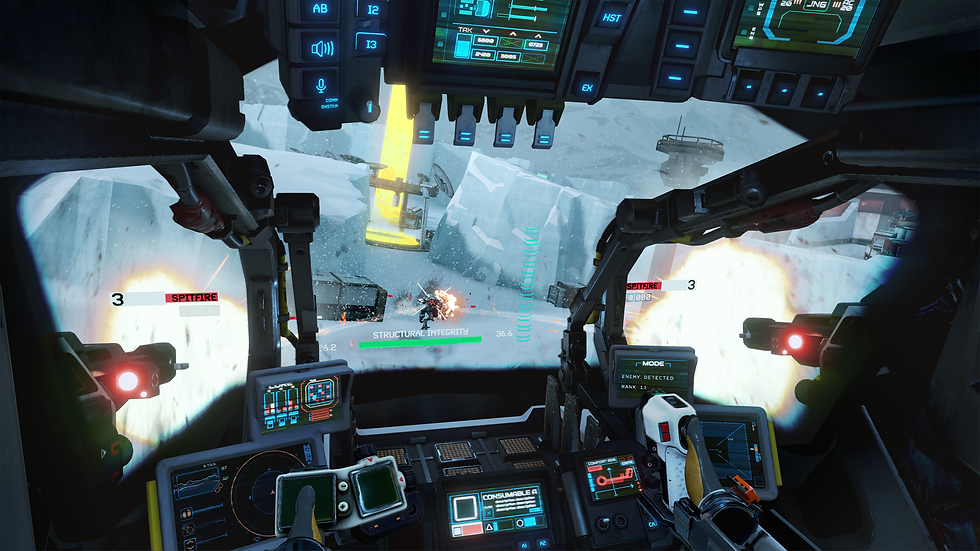
Virtual reality has changed the formula and that's exactly why we built Iron Rebellion. VR solves one of the biggest challenges mech games have historically faced: immersion.
On a traditional screen, a player controls a giant robot. In VR, a player sits inside one.
That distinction dramatically changes the experience. Looking over your shoulder to check for threats, scanning the battlefield through a cockpit canopy, and physically occupying the pilot's seat creates a sense of presence that is difficult to replicate in other formats.
The fantasy has always been about being the pilot.
Mechs: A Different Kind of Vehicle Simulation
Mech piloting isn't trying to replace flight simulation, racing simulation, or space simulation. Instead, it offers a different vehicle to master.
For simulation players who enjoy cockpit immersion, situational awareness, and the process of developing expertise over time, mech piloting presents an interesting challenge that shares many familiar qualities while introducing an entirely different battlefield. The vehicle may be fictional but the skills required to operate it effectively feel surprisingly real.
Situational Awareness
Successful pilots constantly gather information from their environment. Flight simulation players monitor instruments, airspace, terrain, and aircraft position. Space combat pilots track targets, energy management, and threats. In all areas of combat, awareness of enemy positions, cover, terrain, and teammate movements often matters just as much as weapon accuracy.
Vehicle Control
Simulation games reward smooth, deliberate control inputs. Mechs introduce their own version of this challenge. Unlike many traditional shooters, movement isn't simply about running from point A to point B. Pilots must manage positioning, line of sight, engagement angles, and movement timing while operating a large, heavily armed machine.
Continuous Skill Development
One of the most satisfying aspects of simulation gaming is the feeling of gradual improvement. The vehicle doesn't change. The pilot does.
The same principle applies to mech piloting. As players gain experience, they develop better battlefield awareness, stronger positioning habits, and a deeper understanding of how their machine performs in different situations.
At their core, simulation games are about mastery. Whether you're learning to land an aircraft in difficult weather conditions or managing a spacecraft during combat, the appeal often comes from developing proficiency over time. A mech may not fly like a jet or maneuver like a spacecraft, but piloting one effectively requires many of the same habits and decision-making skills.
Experience Mech Piloting for Yourself
If you already enjoy cockpit-based VR experiences, mech piloting may be worth exploring. Jump into the cockpit and let us know what you think.


Comments